Sierra Cole
Kaveh D’Rosario
Alice Ningci Jiang
Kangju Lee
Yuxi Ma
Tech Nix
Cassie Pina
Chloe RadyOwen Roberts
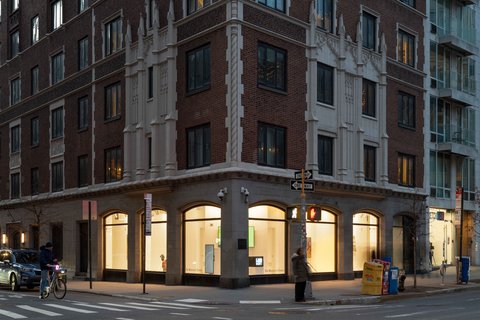
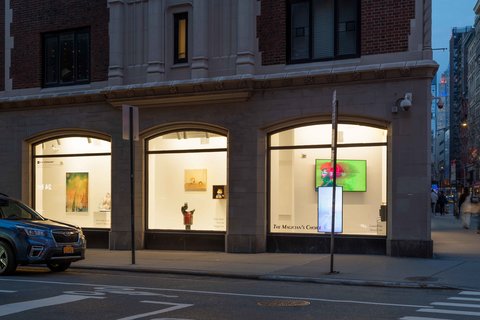
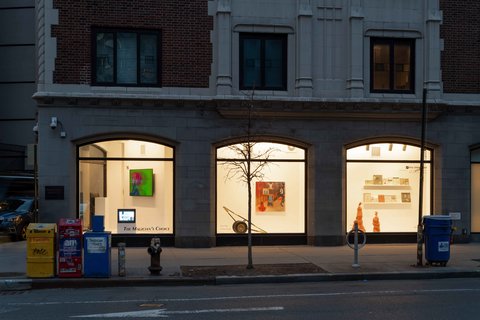
The Magician's Choice is a group exhibition curated by 80WSE Director, Howie Chen, and features the artwork of nine BFA Studio Art Majors in the final year of their undergraduate studies at the New York University Steinhardt School of Culture, Education and Human Development’s Department of Art & Art Professions.
Curated by Howie Chen
Ariel He, Curatorial Assistant
Organized by
Erin Johnson - Director of Undergraduate Studies
Andrew Ordonez - Senior Honors & Studio Coordinator
Silvia Abisaab - Program Administrator and Studio Photographer
Howie Chen - Director, 80WSE Gallery
Jon Huron - Manager, 80WSE Gallery
Kiyomi Taylor - Exhibitions Coordinator, 80WSE Gallery
Ariel He - Curatorial Assistant, 80WSE Gallery
Olivia Andrews - Exhibitions Coordinator
Carter Seddon - Gallery Photographer
Thanks to Silvia Abisaab, Olivia Andrews, Itziar Barrio, Jonathan Berger, Jesse Bransford, Tammy Lee Brown, Marie Catalano, Ken Castronuovo, Howie Chen, Isaiah Davis, Nancy Deihl, Monica Driscoll, Niloufar Emamifar, Neil Goldberg, Hina Haider Fancy, Sho Halajian, Dave Hardy, Jane Harris, Shadi Harouni, Jon Huron, Vonetta Moses, Lila Nazemian, Laurel Ptak, Linda Sormin
A special thanks to the Chen Cui Family Art Practice Fund for their continued support of the BFA Studio Art Program.
*Broadway Windows is a series of five street-level display windows located at the corner of Broadway and East 10th Street. The installations can be viewed 24 hours a day, seven days a week.
Equivocations
Art and magic share an uncanny ability to reveal reality through appearances. Both rely on staged encounters where perception, belief, and attention are subtly directed. Magic takes the tension between freedom and constraint as the basis of its craft. Among the classic techniques in stage magic is the Magician’s Choice, a form of equivocation in which a spectator appears to choose freely while the outcome remains predetermined through strategies known as “force” and “control”. The device takes familiar forms such as a card selection trick or a mentalist’s routine that leads participants to believe the choice is theirs. In contemporary life, the illusion of freedom operates in a similar way, masking the gap between individual agency and the invisible systems that shape our actions.
Earlier cosmologies understood magic as mysterious forces believed to animate the natural world through hidden correspondences between bodies, objects, and events. With the rise of Enlightenment rationalism, magic gradually shifted from a supernatural explanation to performance centered on the figure of the magician and the craft of conjuring. By the nineteenth century, illusionists demonstrated mastery not over invisible spirits but over everyday perception through techniques such as misdirection and equivocation that guide attention and belief of the audience.
The logic of the Magician’s Choice echoes throughout modern institutions and social life. Participatory democracy, consumer capitalism, and digital life each promise agency through choice while quietly structuring its conditions through their own mechanisms of control and force. The artists in this exhibition move within these dynamics. They draw on familiar apparatuses such as boxes, frames, formats, and invitations to engage the viewer. Opening toward uncertainty, the works move from containment toward transformation to reveal how the structures that organize choice might also produce outcomes that escape their logic.
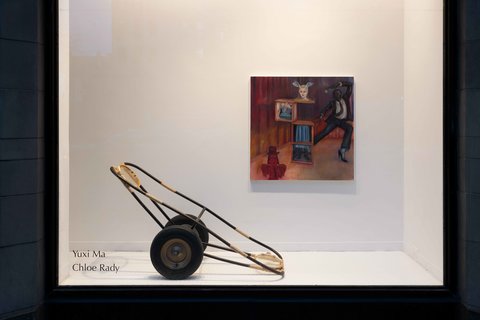
Chloe Rady’s oil paintings draw on classical compositions to examine how femininity and desire are structured through the unsettling gaze of the other. Often referencing historical imagery and theatrical tableau, her work stages figures in libidinally charged scenes that create an ambivalent relation of control and power.
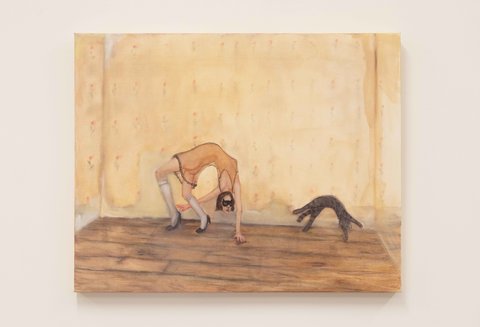
Feral Formalities, 2025
Oil on canvas
28 x 22 in.
Depicting the artist and her cat in mirrored contortions, Feral Formalities (2025) situates the figure of a woman within narratives of female hysteria and confinement, referencing tropes such as the “cat lady” and Charlotte Perkins Gilman’s The Yellow Wallpaper, a canonical story in which a woman confined to a domestic interior gradually unravels under the weight of prescribed care and surveillance. In Step Right Up (2026), Rady reworks the iconic Zig Zag Girl illusion in which a woman appears segmented across stacked boxes as a male magician separates the compartments. The composition recalls traditional images of the Virgin surrounded by angels, but references to fetish imagery and dynamics of domination disrupt this devotional structure to create a scene where the sacred and the profane coexist. The segmented boxes suggest structures that organize the body into divisions controlled by the magician while also recalling the unnatural distortion of the figures explored in Feral Formalities.
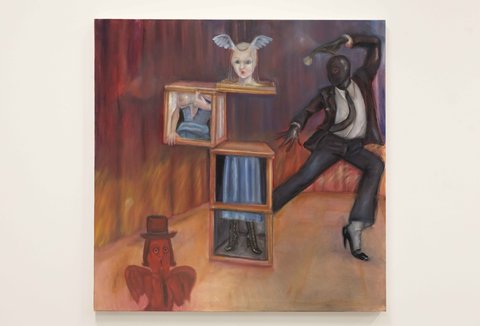
Step Right Up, 2026
Oil on canvas
36 x 36 in.
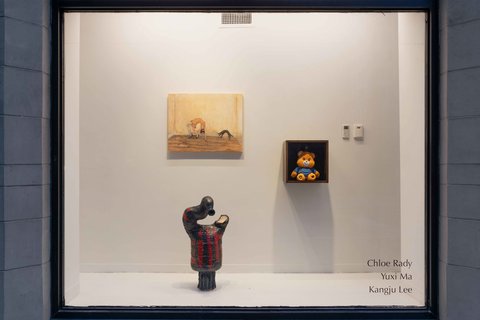
The box as both a literal unit and a metaphor also appears in Kangju Lee’s Price Agreement (2025) where a wooden container mounted on the gallery wall holds a five-dollar teddy bear. In an early activation of the work, viewers were invited to trade the object inside for another they considered of comparable value with the stuffed toy as the initial object. As each participant replaces the item, the contents of the box change to reveal how judgments of worth fluctuate in response to social and psychological factors at play.
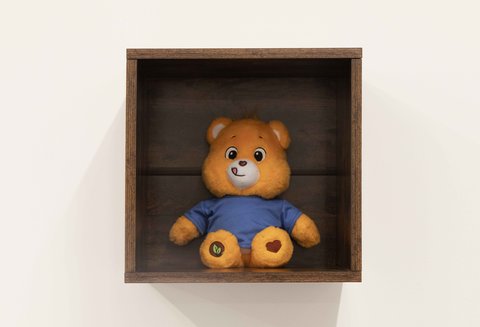
Price Agreement, 2025
Plushy doll, wood
17 x 17 x 7 in.
Working with the logic of a magician’s apparatus in exchange markets and participatory artwork, the piece reflects Lee’s broader practice which considers how meaning and value shift as they pass through people and systems. Drawing from the metaphor of the childhood “Telephone game,” she examines how ideas distort through circulation even as they remain permanently altered by the abstractions of social and economic interaction. Over time, the sequence of trades reveals what is socially acceptable, suggesting that what appears to be free choice is quietly shaped by the normative boundaries that people collectively construct.
Yuxi Ma’s objects and installations require activation by participants, foregrounding the bounded improvisational relationship between artwork and viewer. The artist sets the terms of the encounter and defines the form and conditions of engagement. Participants act within terms established by the artist, not unlike a magician arranging the circumstances of an illusion for an audience. Within this dynamic, freedom and control come into tension within the social realm of aesthetics.
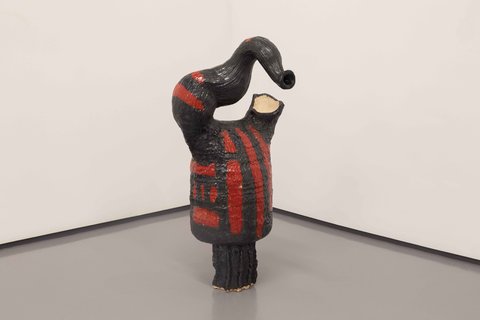
Spiral Brass Horn, 2025
Glazed ceramics
31 x 15 x 8 in.
Spiral Brass Horn (2025) began as an intuitive ceramic vessel before evolving into a sound sculpture where breath passes through the form and resonates outward, activating the piece as a kind of ritual instrument. The work’s organic form rises upward in segments that resemble plant forms and bodily limbs, guiding breath through the object and projecting it as amplified sound. Tennis Seesaw, a discarded object found in Bushwick and minimally modified with tennis racket attachments preserves the memory of its previous life while transforming its purpose. The sculpture maintains a structure in which two participants respond to each other’s movement while shifting the dynamic from adversarial play toward collaborative exchange.
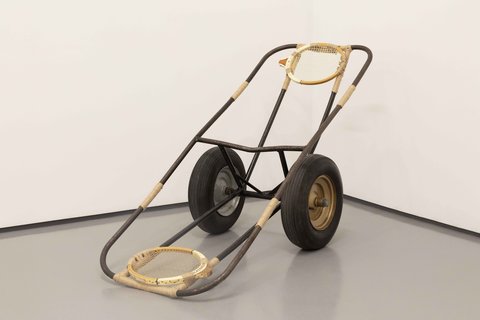
Tennis Seesaw, 2025
Reclaimed metal rack with wheels, tennis rackets, jute rope
60 x 22 x19 in.
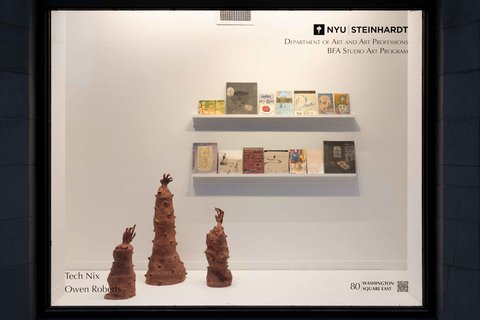
Owen Roberts’s title TK (2025) presents a series of paintings executed on found book covers and arranged in sequence on linear shelves. Within these groupings he constructs implied scenes populated by melancholy faces, grotesque humor, and moments of quiet absurdity. The figures emerge from the textures and worn surfaces of the covers themselves. Embossing, stains, and fabric grain become prompts that guide the composition. Roberts draws on personal history, family memories, and fragments of inherited religious imagery to construct these intimate vignettes.
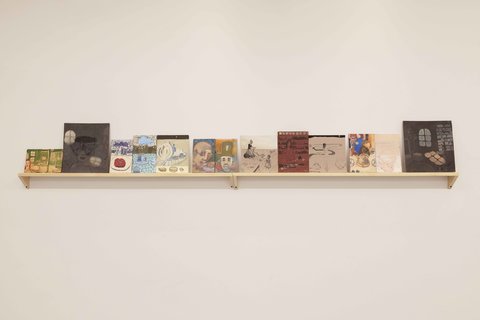
I cried because I said nothing, 2025
Oil and ink on board and cloth, shelves
Dimensions variable
Influenced by compositions of eighteenth-century French painters and continental aesthetic traditions, Roberts adapts these references to the vertical proportions and material constraints of the book cover. Some subjects appear diagrammatic while others are loosely painted or drawn, producing shifts in tone from one cover to the next. Resembling fragments of an unfolding world, each picture remains contained on the readymade surface, echoing the boxed structures that recur throughout the exhibition.
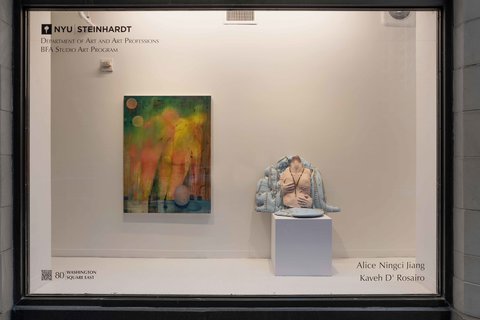
Painting can function as a site where different representational orders converge and are held in relation. Across her practice, Alice Ningci Jiang brings together different pictorial languages, particularly Chinese ink traditions and Western painting alongside frameworks that reference how knowledge is organized. She often combines loose brushwork influenced by Chinese ink painting with shadowed forms, repeated marks, and schematic elements that resemble scientific notation. The compositions draw on diagrammatic structures that suggest systems of explanation, yet the marks remain gestural and open-ended.
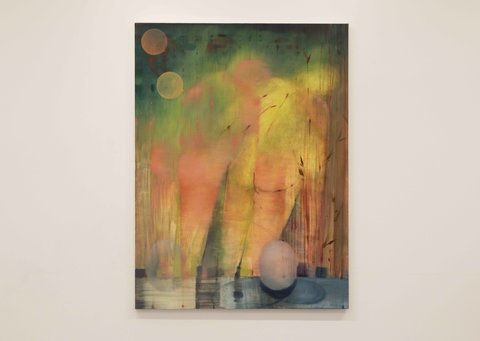
Two Butts Waiting for Something to Happen, 2025
Oil on Canvas
36 x 48 in.
In Two Butts Waiting for Something to Happen (2025), two anonymous naked figures are shown from behind directing attention to the body as an incomplete and ambiguous sign. Within the painting, the bodies are rendered through different line work against a variegated background so that the figures appear to belong to a distinct visual language with figuration and abstraction existing in tension with each other. By placing these representational devices within the same pictorial space, the work suggests a way of moving beyond the limits of any single category into the space of equivocation.
Working across installation, sculpture, and performance, Kaveh D’Rosario returns to the human body as the site where identity, culture, and memory converge. Drawing from their experience as a queer Sri Lankan raised within Abrahamic religious traditions, their work follows how the self moves through systems of belief and authority that shape gender, sexuality, and trans subjectivity. In Chamber (2024), this inquiry turns toward the artist’s chest, a part of themself charged with tension as they sought to masculinize it beyond what testosterone could transform. To create the work, D’Rosario invited others to physically position their hands on their body, a gesture shaped by their earlier discomfort with touch and embodiment.
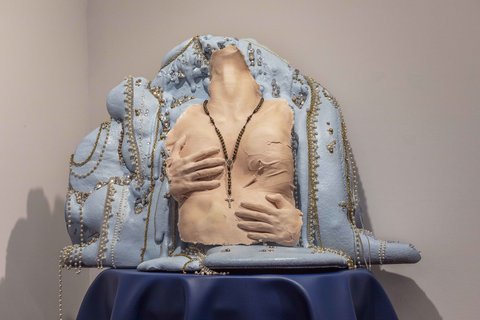
Chamber, 2024
Pigmented resin, carved foam, plaster, acrylic paint, plastic pearl beads, silver trimming, plastic and glass diamonds
25 x 15 x 10 in.
The cast torso rests on a jeweled cushion-like support, poised between offering and display where the language of adornment casts a devotional charge to the sculpture. The composition frames the form within the field of the sacred and ornamental where vulnerability becomes an opening through which new subjectivities begin to entangle and transform.
Extending the body as a generative site, Tech Nix’s see where there are teeth (2025) presents a cluster of stalagmite-like clay forms from which sculpted eyes and hands emerge. Rising as if through sediment, the figures evoke bodies partially buried in the midst of transformation. Inspired by caves, geological formation, and Drexciya, the Afrofuturist techno mythology about underwater descendants of Africans lost during the transatlantic slave trade, the work imagines bodies adapting to aquatic environments, accumulating barnacle-like attachments and reshaping over time.
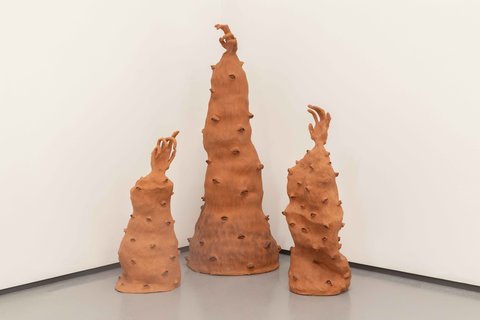
see where there are teeth, 2025
Bisqued terracotta
Dimensions variable
Across their practice, the artist explores questions of Black and trans diasporic identity through material, bodily change, and extended duration. They often work with manufactured red clay, a material that recalls African ceramic traditions while also acknowledging the diasporic distance from a geographic origin. In see where there are teeth, bodies do not appear whole or settled. Eyes and hands emerge from the clay as if surfacing from another environment, suggesting forms that continue to adapt and persist under adverse conditions.
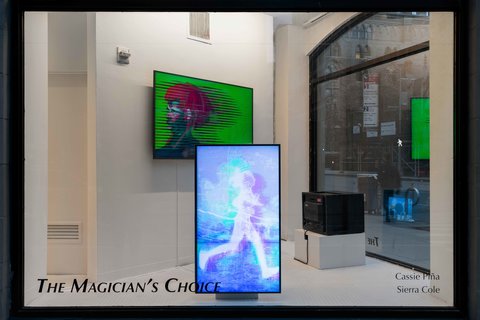
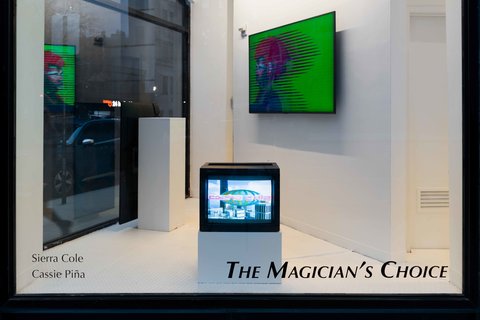
Across her practice, Sierra Cole works with 3D modeling, computer graphics, and collage to construct avatars and environments that center queer Black femininity within digital culture. Her figures inhabit stylized virtual spaces shaped by animation, gaming, and online media.
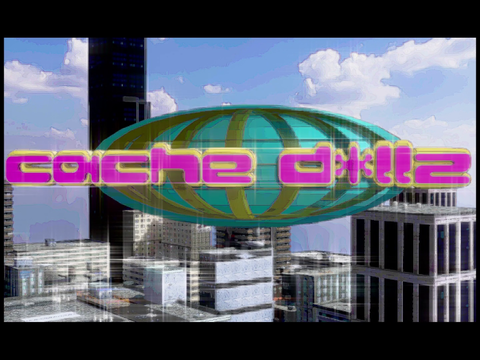
Cache Dollz_City Living, 2025
Single-channel digital video
0:12 min.
Cache Dollz_City Living (2025) and Cache Dollz_matrix (2025) introduce characters from her digital brand, “Cash Dolls,” drawing on the visual language of Y2K toy commercials and early digital animation. Cache Dollz_City Living takes the form of a low-resolution promotional video for the project and resembles both a television advertisement and the looped screensavers once common on early personal computers. In Cache Dollz_matrix, a futuristic avatar stands against an intense green background as its silhouette splinters into a series of glitched lines.
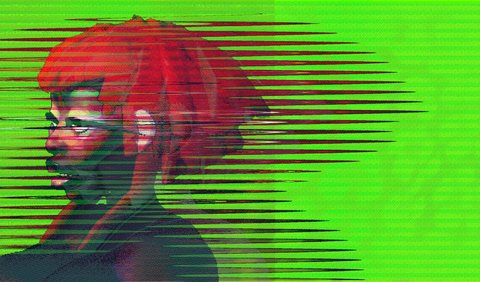
Cache Dollz_matrix, 2025
Digital image
Dimensions variable
In these works, the avatar becomes another form of embodiment. It allows the artist to create proxies that move from material space into digital environments while imagining new ways for a body to appear and circulate.
Bringing together unlikely social spaces and activities, Cassie Pina’s PARTYGIRL (2024) merges the visual language of nightlife with the embodied experience of long-distance running. Images of New York City’s West Side Highway skyline are overlaid with scenes from the famed nightclub Le Bain where bright LED-like colors and video effects evoke the sensory intensity of a dance floor. A silhouette moves through this hybrid environment, collapsing athletic endurance and queer nightlife into a single field of motion.
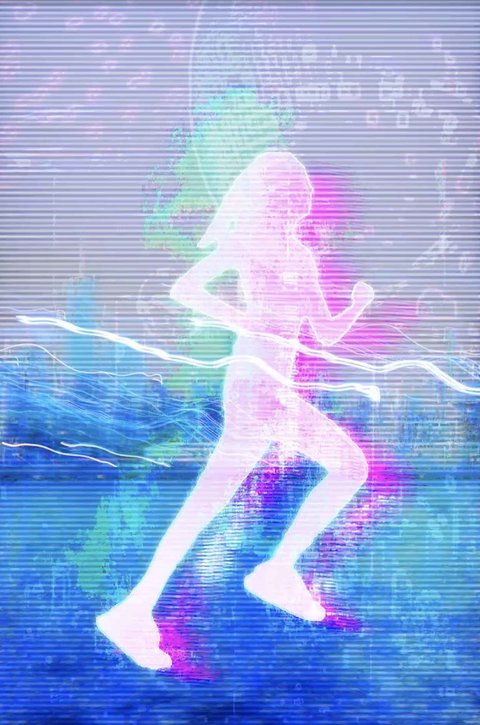
PARTYGIRL, 2024
Single-channel digital video
0:46 min.
Across her practice, Pina works at the intersection of queerness and athletic culture. PARTYGIRL grows from the contradictions she identifies within track sport: a culture shaped by rigid masculinity that nonetheless produces moments of intimacy between bodies. The piece draws on her experience of running in New York City at night where the exercise generates a physical state similar to the atmosphere of electronic dance floors. The work imagines the convergence of disparate spaces as a site of embodied release where movement generates euphoria and the body finds freedom within that intensity.
Where earlier works in the exhibition stage bodies within structures of control and segmentation, Pina’s figure traverses multiple realms and synthesizes bodily experience across these spaces, dissolving existing boundaries with the desire for emancipation.
- Howie Chen
Curator, Director 80WSE